Basics


Info Download

Advanced

v/v
V
V

Plot Download

Kaneko operated entirely within Japan's "Under 15" (U-15) idol ecosystem. During the 2000s, this industry legally published non-explicit, innocent-themed model photography focusing on school uniforms, traditional clothing, sportswear, and casual swimwear.

Miho Kaneko has several exciting projects lined up for the future. While specific details are scarce, fans can look forward to seeing her in:

Miho Kaneko is a name that often surfaces in discussions surrounding the "Junior Idol" industry in Japan, specifically in relation to the Imouto (Little Sister) genre of media production. To provide an interesting and comprehensive write-up, it is necessary to look beyond just a filmography and examine the cultural context, the aesthetic of the era, and the complexities of that specific industry.

and the broader "junior idol" industry—is a complex exploration of fame, the commodification of childhood, and the ethical boundaries of Japanese media culture. The Evolution of Child Performance Standards

The availability of Kaneko's vintage modeling work has fundamentally shifted due to a sweep of legislative reforms:

Because physical media containing Miho Kaneko’s early work went out of print in Japan, digital preservation communities and archival sites became the primary places where her past modeling portfolios were indexed. The pairing of the two terms in search queries is typically an artifact of internet users seeking out specific peer-to-peer (P2P) files, image boards, or streaming mirrors that hosted old, out-of-print video clips and photo series from her active years. Media Landscape and Digital Preservation Context
Disclaimer: This tool is provided for educational and illustrative purposes only. No guarantee is made regarding accuracy, suitability, or performance. Use at your own risk. - Copyright: ufelectronics.eu / Andreas Dyhrberg

×
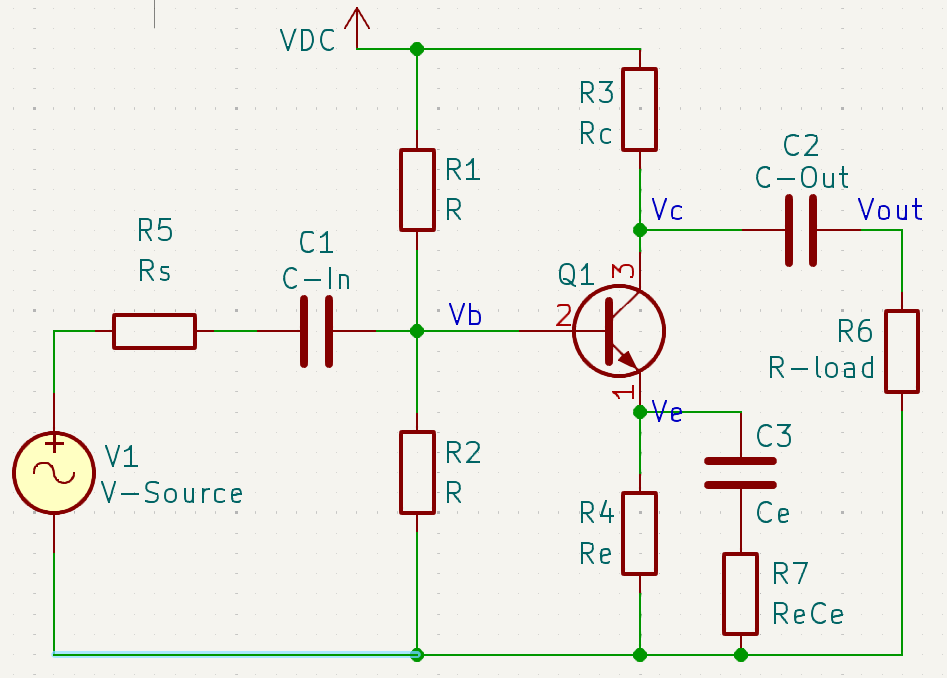
Amplifier Schematic
×

There are different ways to calculate an amplifier, depending on what you want to achieve.

Maybe you want to achieve a certain gain, as far as possible (classic mode). Or you have a low Vcc to respect (modern mode). Or you work with analog audio amps (symmetry mode).

Depending on what you want to achieve and the way of calculating it. Some fields might become dependent on others, or the other way around.

Your above choise makes some input fields available for manipulation, while hiding others.


🎯 1. Target Gain (Av) — "Classic mode" miho kaneko from imoutotv

You care about how much your amplifier multiplies the input signal.

Set desired voltage gain and Rc voltage drop. Best for learning and simple amplifiers.

You say: “I want a gain of 10.”
The app adjusts resistors to try and match that.
You must give Av and Vrc (the voltage dropped across Rc).

Best for common emitter amplifiers.

✅ Default choice for most beginners and educational use. Kaneko operated entirely within Japan's "Under 15" (U-15)


⚡ 2. Target Emitter Voltage (Ve) — "Modern mode"

You care about setting a healthy DC bias point.

Prioritize stable biasing via Ve. Useful for low-voltage circuits or precision designs.

You say: “I want Ve = 0.5 V, to keep the transistor out of trouble.”
This makes sure your transistor stays in active mode.
Gain becomes whatever it turns out to be.

Ideal for common emitter amplifiers when the goal is to ensure proper biasing for low-voltage or precision circuits, and it’s also used in class AB amplifiers to prevent distortion While specific details are scarce, fans can look

✅ Useful in low-voltage designs (e.g., 3.3V systems).


🧭 3. Target Collector Voltage (Vc) — "Symmetry mode"

You want to place the collector in the middle of the power rail.

Target Vc = Vcc/2 for maximum signal swing. Great for audio and analog signals.

You say: “Make Vc = Vcc/2” for maximum swing.
Useful for analog audio amps or symmetrical headroom.
Gain and Ve are outcomes.

Best for common collector amplifiers and class AB amplifiers.

✅ Best for signal integrity.

Miho Kaneko From Imoutotv -

Kaneko operated entirely within Japan's "Under 15" (U-15) idol ecosystem. During the 2000s, this industry legally published non-explicit, innocent-themed model photography focusing on school uniforms, traditional clothing, sportswear, and casual swimwear.

Miho Kaneko has several exciting projects lined up for the future. While specific details are scarce, fans can look forward to seeing her in:

Miho Kaneko is a name that often surfaces in discussions surrounding the "Junior Idol" industry in Japan, specifically in relation to the Imouto (Little Sister) genre of media production. To provide an interesting and comprehensive write-up, it is necessary to look beyond just a filmography and examine the cultural context, the aesthetic of the era, and the complexities of that specific industry.

and the broader "junior idol" industry—is a complex exploration of fame, the commodification of childhood, and the ethical boundaries of Japanese media culture. The Evolution of Child Performance Standards

The availability of Kaneko's vintage modeling work has fundamentally shifted due to a sweep of legislative reforms:

Because physical media containing Miho Kaneko’s early work went out of print in Japan, digital preservation communities and archival sites became the primary places where her past modeling portfolios were indexed. The pairing of the two terms in search queries is typically an artifact of internet users seeking out specific peer-to-peer (P2P) files, image boards, or streaming mirrors that hosted old, out-of-print video clips and photo series from her active years. Media Landscape and Digital Preservation Context